Our project slipped 6 weeks: what happens to the crew's accommodation?
It depends on the cancellation terms agreed when the beds were booked, not on the conversation when the project slips. A later start costs the most on non-refundable short lets and the least on monthly stays with 30 days' notice; a later finish is a question of availability and of the legal lines a longer stay can cross. Bonjour Residences data shows about one crew stay in four ends on a different date than booked, so bookers should treat the slip as the plan, not the exception.
| 30%of projects delayed in the past year (Currie & Brown, Oct 2026) | 46%of construction leaders confident of meeting deadlines | 1 in 4of our crew stays ended on a different date than booked (n=201) | 35%of our bookings with recorded terms were non-refundable (n=136) |
A six-week slip feels like a scheduling problem. For the booker it is a contract problem, and the contract was signed weeks earlier, usually at the cheapest rate on the day.
Why should bookers plan for the slip?
Because it is now normal. Currie & Brown's Construction Certainty Index, published on 6 October from a survey of more than 1,300 construction and infrastructure decision makers, found that 30% of projects were delayed over the past year. Only 46% of respondents are confident of meeting deadlines, down 12 points in a year.
The causes in the last three weeks alone: on 6 October Finland's permit and supervision agency, LVV, told Google's subsidiary Tuike Finland to suspend site works at its Muhos and Kajaani data centres by 23 October until environmental assessments are complete. On 8 October Construction News reported a bridge replacement in Weston-super-Mare running at least five months late because summer heat stopped piling beside the railway. On 24 September the Guardian reported that a planned AI data centre in Loughton, Essex, may wait until the early to mid-2030s for grid power.
Permits, weather and power. None of them is something a booker controls. All of them land on the accommodation.
What happens if the start date moves?
You pay for empty beds, and how many depends on the terms. Jersey's health minister told the States Assembly this month that the government is paying rent on accommodation units "which have voids" while it hunts for beds for an 800-worker hospital build. A crew of ours whose project slipped three weeks this autumn was charged from the original arrival date.
Of 136 bookings in our system with recorded cancellation terms, 48 (35%) were non-refundable and 86 (63%) could be ended on 30 days' notice [Bonjour Residences OS, 12 October 2026]. On 30 days' notice, a six-week slip costs at most a month. On a non-refundable short let it costs the whole booking, plus rebooking at a later, tighter date.
| How the beds were booked | Start slips 6 weeks | End slips 6 weeks |
|---|---|---|
| Hotel rooms, flexible rate | Usually cancel free shortly before arrival, at a higher nightly price | Night by night, if rooms are free; event weeks push crews out |
| Hotel group block | Cancellation and attrition charges grow as arrival nears | Block ends on the contract date; extra nights at the rate left |
| Short let, non-refundable | The money is gone, plus the cost of rebooking | Next guest often booked; the crew may have to move mid-job |
| Monthly stay, 30 days' notice | Give notice now: up to 30 days paid, or hold the flat | Extend by the month, usually in the same flat |
| Rolling monthly | Pay month by month, or stop with notice | Nothing to rebook; watch the legal lines below |

What happens if the end date moves?
This is the more common slip. Of 201 crew stays in our system, 153 ended on the booked date. 23 were extended and 25 ran on a rolling monthly basis, so roughly one in four finished on a date nobody wrote down at the start.
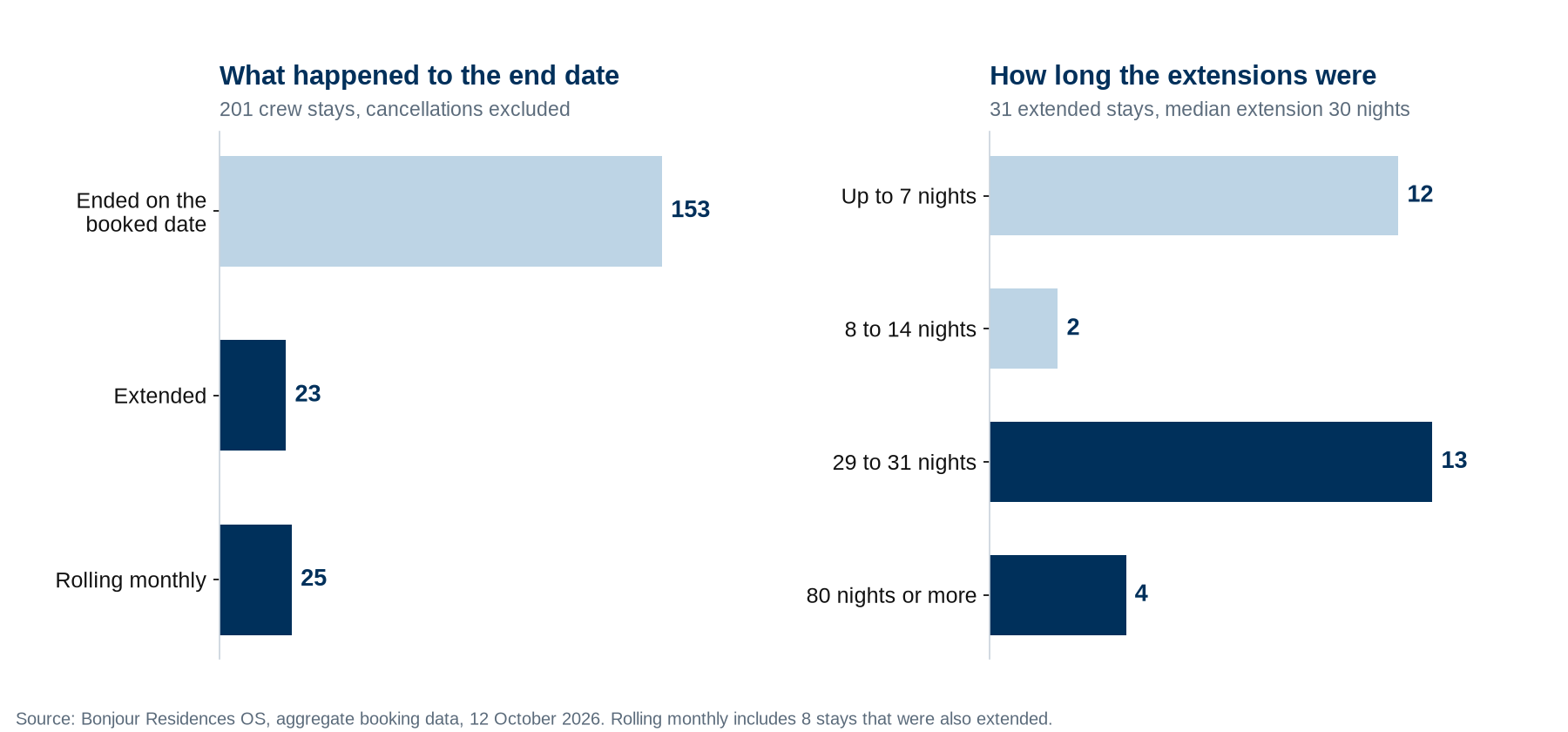
The extensions came in two shapes. Twelve were a week or less, the snagging tail of a job. Seventeen were a month or more, with a median of 30 nights across all 31 extensions. Projects do not overrun by a night. They overrun by a phase.
A longer stay also crosses legal lines. In Ireland, lets of up to 21 nights must be registered with Fáilte Ireland from December, while a tenant who stays six continuous months in a new tenancy gains security of tenure, which makes owners wary. In the UK, accommodation at a temporary workplace stops qualifying for tax relief once it is reasonable to assume continuous work there will last more than 24 months (ITEPA 2003, section 339(5)). A slip can trigger that line the day the new programme is issued.
What should bookers do differently?
- Read the cancellation terms before the price. On a project with any permit, grid or weather risk, a non-refundable rate is a bet on the programme.
- Book the phase by the month. Monthly stays on 30 days' notice cap the cost of a late start and make an overrun a one-line extension. Our clients have saved 20-30% by using the correct market for the length of stay.
- Ask for the extension option in writing, for at least a month, at the time of booking. The flat is easiest to keep before the owner takes the next guest.
- Give notice the day the delay is known.
- Re-check the legal lines when the programme changes: registration numbers on short lets, tenancy rights past six months in Ireland, the 24-month rule in the UK.
Related: How much notice do project teams give for crew accommodation?, How do contractors find accommodation for workers in Ireland? and Is crew accommodation a taxable benefit in the UK?
FAQ
Do we pay for crew accommodation if the project start is delayed?
Usually, for part of it. Non-refundable bookings are paid in full; monthly stays on 30 days' notice cost up to a month if notice is given promptly. Check the terms the day the delay is known.
Can a crew extend its stay if the project overruns?
Often, if the extension is agreed before the owner takes the next booking. Overruns tend to come in blocks of about a month, so ask for a monthly extension option at the time of booking.
Does a longer project change the tax treatment of crew accommodation in the UK?
It can. Relief for accommodation at a temporary workplace ends once continuous work there is expected to exceed 24 months, so a revised programme can change the position before the 24 months pass.
- Currie & Brown, Construction Certainty Index 2026, press release 6 October 2026 and executive summary.
- Lupa- ja valvontavirasto (Finnish Permit and Supervision Agency), Tuike Finland Oy asked to suspend preparatory works at Muhos and Kajaani data centre projects, 6 October 2026.
- Construction News, High temperatures delay Octavius bridge job by five months, 8 October 2026.
- The Guardian, Launch of UK's largest AI supercomputer delayed by power supply problems, 24 September 2026.
- Construction News, Jersey minister admits challenges of housing workers for GBP 710m build, 2 October 2026.
- Department of Enterprise, Tourism and Employment, Short Term Letting and Tourism Bill, 6 October 2026.
- Residential Tenancies Board, Tenant's right to stay in a rented property from 1 March 2026, checked 11 October 2026.
- Income Tax (Earnings and Pensions) Act 2003, section 339, legislation.gov.uk, checked 12 October 2026.
- Bonjour Residences OS, aggregate booking data, 12 October 2026 (201 stays, cancellations excluded; 136 with recorded cancellation terms).

Contact us today to discuss your next project