Fast Wheelchair Accessible Housing: Checklist, Rights & Managed Options
Search major listing sites using accessible filters, check your city’s housing portal for set-aside units, and message property management directly to confirm specific features before you tour. That combination covers both public inventory and the units that never make it into a listing. Whatever you find, remember that housing providers must consider reasonable accommodation requests under fair housing law, so a unit that looks close but not quite right may still work with a modification.
TL;DR:
- Listing filters often don’t fully capture accessible features, so verifying descriptions and asking direct questions improves chances of finding suitable units.
- Concrete features like zero-step entries, roll-in showers, and door widths of 32 to 36 inches are essential to confirm during property visits or inquiries.
- Most accessible units are required to meet federal standards, but always verify that a unit is one of the designated accessible units rather than just equipped with basic features.
- Requesting reasonable accommodations involves clear communication, documentation only when needed, and following up in writing, with escalation options if denied.
- Using a managed accommodation supplier can significantly speed up securing accessible housing, especially when time is limited or multiple locations are involved.
Table of Contents
- Where to search and how to use listing filters effectively
- What wheelchair-accessible features and ‘accessible’ labels mean in listings
- Your rights: reasonable accommodations and key federal standards
- How to request an accessible unit or a reasonable accommodation
- When a serviced or corporate supplier handles accessible placements faster
- Quick priorities when choosing a wheelchair-accessible rental
- How Bonjour Residences secures accessible furnished placements
- FAQ
- Sources
Where to search and how to use listing filters effectively
Mainstream rental sites increasingly let you filter by accessibility, but the filter alone rarely tells the full story. Search the listing description for phrases like “wheelchair access,” “accessible,” “roll-in shower,” or “no-step entry,” since many platforms only tag a unit as accessible when the landlord manually checked a box, and plenty of genuinely accessible units never get flagged.
Municipal housing portals are worth checking in parallel. Programs like NYC’s housing resources for people with disabilities set aside specific units for mobility, hearing, or vision disabilities, often tied to federal compliance requirements, and some developments advertise exact unit counts reserved for applicants with mobility needs.
Direct contact with property management often surfaces units that never reach public listings. A short message with a clear checklist speeds this up:
- Confirm door and hallway clearance width in inches
- Ask whether the bathroom has a roll-in or curbless shower
- Ask about elevator access if the unit is above ground floor
- Ask whether grab bars are installed or can be added
What wheelchair-accessible features and ‘accessible’ labels mean in listings
An “accessible” label can mean very different things depending on who wrote it. Concrete features to look for include zero-step entry or a ramp, door clearances of 32 to 36 inches, roll-in or curbless showers, switches and outlets mounted at reachable heights, reinforced walls for grab bars, and enough turning space in the kitchen and bathroom for a wheelchair.
Section 504 guidance notes that new multifamily construction generally must make 5% of units accessible for people with mobility impairments and 2% accessible for sensory disabilities, with required features like accessible routes and reinforced walls for grab bars, according to HUD’s Section 504 compliance guidance. That is a floor, not a guarantee of quality, so always verify the unit in question is one of those designated units rather than a general unit with a ramp bolted on.
Listing terminology matters too:
- “Accessible” usually means features are already installed and usable
- “Adaptable” means the structure supports future modification, not that it is move-in ready
- “Visitable” often means just one entrance and bathroom are reachable, not the whole unit
Watch for red flags in photos: a single shot of a walkway with no threshold detail, or a bathroom photo cropped to avoid showing the shower entry, usually means the feature you need is not actually there.
Your rights: reasonable accommodations and key federal standards
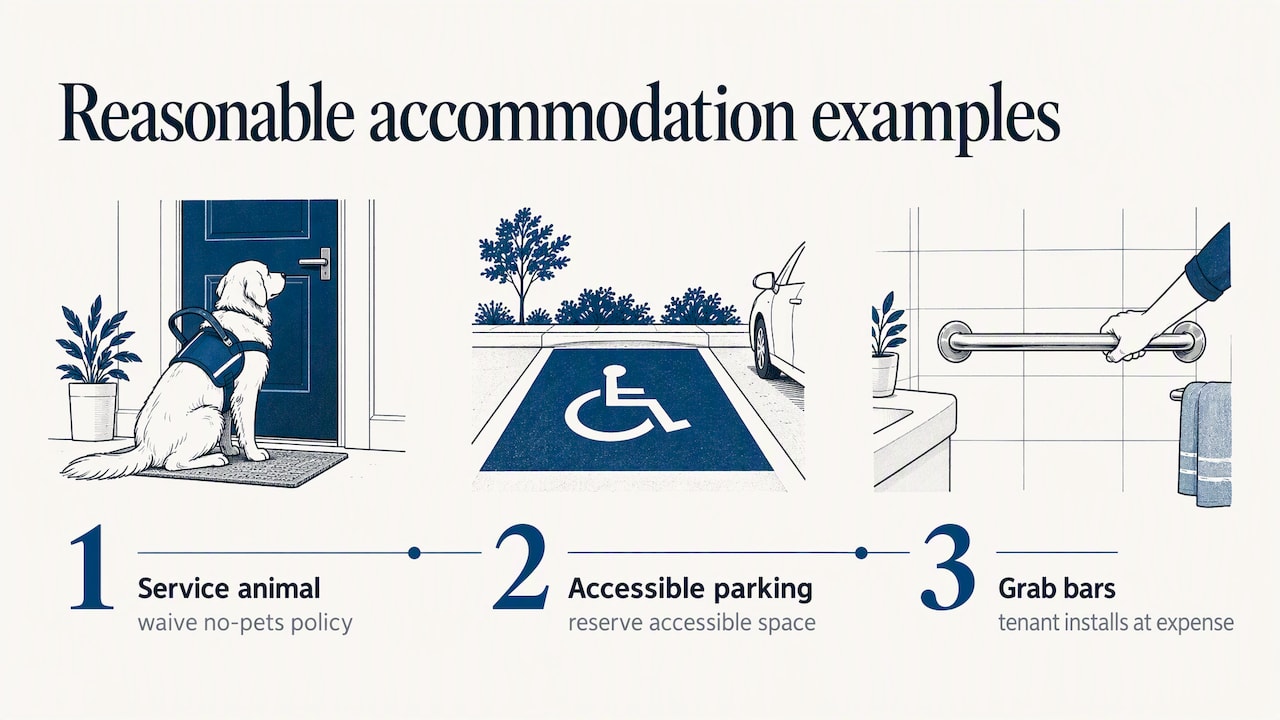
Under the Fair Housing Act, a reasonable accommodation is a change to rules, policies, practices, or services that gives a person with a disability an equal opportunity to use and enjoy a home, according to the HUD/DOJ joint statement on reasonable accommodations. This commonly covers things like waiving a no-pets policy for a service animal, reserving an accessible parking space, or allowing a tenant to install grab bars at their own expense.
Knowing these numbers helps you ask the right question: not just “is there an accessible unit,” but “is this building covered, and how many accessible units does it have.”
Documentation only comes into play when a disability or need is not obvious. When it is not apparent, a housing provider may request documentation sufficient to establish what HUD calls an identifiable nexus between the disability and the requested accommodation, but providers cannot demand more than that nexus requires.
If a request is denied, document every interaction in writing, then contact your local fair housing agency or file a complaint with HUD.
That paper trail matters if you need to escalate later.
How to request an accessible unit or a reasonable accommodation
A clear, repeatable sequence saves time and keeps a record if you need to escalate.
- Identify candidate units through listings, portals, or direct outreach
- Send a short written request naming the specific feature you need and why
- Offer documentation only if asked, and only what establishes the nexus to your need
- Get the provider’s response in writing, including any timeline given
- Follow up in writing, then escalate to your local public housing authority or HUD if the request is denied or ignored
Pro Tip: Keep your first message short: name the feature, your mobility device if relevant, and your target move-in date, rather than your full medical history.
Most providers respond within a couple of weeks. If a request involving a Section 8 voucher stalls because no unit fits within the standard payment range, ask about a reasonable accommodation exception payment standard, which HUD guidance allows public housing authorities to approve up to 120% of the standard rate case by case.
When a serviced or corporate supplier handles accessible placements faster
Public listings and portals work well when you have time to search and negotiate. When you do not, a managed accommodation supplier can be the faster route. At Bonjour Residences, we source and manage furnished accommodation for contractor, project, and insurance relocation teams across 27 European markets and the UK, including custom filtering for accessibility needs alongside pets and school catchment requirements.
- We aim to house teams quickly after inquiry
- We handle sourcing, booking, and check-in through one point of contact instead of multiple vendors
- We issue one consolidated invoice regardless of how many locations or landlords are involved
- We provide support for both the guest and the manager throughout the stay
This approach tends to suit project managers coordinating multiple team members, insurers arranging urgent relocations, and anyone who needs a guaranteed accessible unit without chasing listings.
Quick priorities when choosing a wheelchair-accessible rental
Usability beats marketing labels every time: a unit calling itself “accessible” with a 30-inch doorway helps no one. If mobility is essential day to day, prioritize units with features already installed over ones merely described as adaptable. Accept a short-term retrofit only when the landlord commits to it in writing and on a fixed timeline.
— Fan
How Bonjour Residences secures accessible furnished placements
When a search deadline is tight, the sourcing and back-and-forth that public listings require can cost more time than a team has. Our process is designed to remove that friction with tailored accessibility filtering alongside pet and school requirements, partnerships for better rates, and a single consolidated invoice regardless of how many team members or locations are involved.
- We confirm accessible features like roll-in showers and door clearances before you commit, not after move-in
- We coordinate with property owners directly, which tends to mean faster answers than general listing inquiries
- We support both long-term project placements and urgent insurance relocation housing
If your team needs an accessible unit on a short timeline, our contractor accommodation service is built for exactly that situation. Reach out with your requirements and we will start sourcing options right away.
This article is general information, not a substitute for advice from a qualified lawyer. Consult a qualified legal professional about your own circumstances before acting on anything here.
FAQ
What does an accessible apartment look like?
A genuinely accessible apartment has zero-step entry or a ramp, door and hallway clearances of 32 to 36 inches, a roll-in or curbless shower, reachable switches and outlets, and reinforced bathroom walls for grab bars. Buildings above ground floor also need working elevator access to the unit itself, not just the lobby.
Where can I find wheelchair-accessible apartments in New York City?
Start with NYC’s housing resources for people with disabilities, which lists Housing Connect lotteries that set aside units for mobility, hearing, or vision disabilities. Mainstream listing sites with accessibility filters and direct outreach to property managers fill in the gaps the portal does not cover.
What are some housing options for disabled adults in Memphis, Tennessee?
Local public housing authorities and nonprofit housing agencies in Memphis typically maintain accessible unit lists and can explain reasonable accommodation exceptions on Section 8 vouchers. Checking with the local public housing authority directly is usually faster than relying on general listing searches alone.
How to get an apartment with SSI disability?
SSI itself does not grant housing, but it can support a Section 8 voucher application or a reasonable accommodation request tied to your income. If a standard voucher payment does not cover an accessible unit in your area, ask your public housing authority about a reasonable accommodation exception payment standard, which can be approved up to 120% of the usual rate.
Sources
Recommended
Search major listing sites using accessible filters, check your city’s housing portal for set-aside units, and message property management directly to confirm specific features before you tour. That combination covers both public inventory and the units that never make it into a listing. Whatever you find, remember that housing providers must consider reasonable accommodation requests under fair housing law, so a unit that looks close but not quite right may still work with a modification.
TL;DR:
- Listing filters often don’t fully capture accessible features, so verifying descriptions and asking direct questions improves chances of finding suitable units.
- Concrete features like zero-step entries, roll-in showers, and door widths of 32 to 36 inches are essential to confirm during property visits or inquiries.
- Most accessible units are required to meet federal standards, but always verify that a unit is one of the designated accessible units rather than just equipped with basic features.
- Requesting reasonable accommodations involves clear communication, documentation only when needed, and following up in writing, with escalation options if denied.
- Using a managed accommodation supplier can significantly speed up securing accessible housing, especially when time is limited or multiple locations are involved.
Table of Contents
- Where to search and how to use listing filters effectively
- What wheelchair-accessible features and ‘accessible’ labels mean in listings
- Your rights: reasonable accommodations and key federal standards
- How to request an accessible unit or a reasonable accommodation
- When a serviced or corporate supplier handles accessible placements faster
- Quick priorities when choosing a wheelchair-accessible rental
- How Bonjour Residences secures accessible furnished placements
- FAQ
- Sources
Where to search and how to use listing filters effectively
Mainstream rental sites increasingly let you filter by accessibility, but the filter alone rarely tells the full story. Search the listing description for phrases like “wheelchair access,” “accessible,” “roll-in shower,” or “no-step entry,” since many platforms only tag a unit as accessible when the landlord manually checked a box, and plenty of genuinely accessible units never get flagged.
Municipal housing portals are worth checking in parallel. Programs like NYC’s housing resources for people with disabilities set aside specific units for mobility, hearing, or vision disabilities, often tied to federal compliance requirements, and some developments advertise exact unit counts reserved for applicants with mobility needs.
Direct contact with property management often surfaces units that never reach public listings. A short message with a clear checklist speeds this up:
- Confirm door and hallway clearance width in inches
- Ask whether the bathroom has a roll-in or curbless shower
- Ask about elevator access if the unit is above ground floor
- Ask whether grab bars are installed or can be added
What wheelchair-accessible features and ‘accessible’ labels mean in listings
An “accessible” label can mean very different things depending on who wrote it. Concrete features to look for include zero-step entry or a ramp, door clearances of 32 to 36 inches, roll-in or curbless showers, switches and outlets mounted at reachable heights, reinforced walls for grab bars, and enough turning space in the kitchen and bathroom for a wheelchair.
Section 504 guidance notes that new multifamily construction generally must make 5% of units accessible for people with mobility impairments and 2% accessible for sensory disabilities, with required features like accessible routes and reinforced walls for grab bars, according to HUD’s Section 504 compliance guidance. That is a floor, not a guarantee of quality, so always verify the unit in question is one of those designated units rather than a general unit with a ramp bolted on.
Listing terminology matters too:
- “Accessible” usually means features are already installed and usable
- “Adaptable” means the structure supports future modification, not that it is move-in ready
- “Visitable” often means just one entrance and bathroom are reachable, not the whole unit
Watch for red flags in photos: a single shot of a walkway with no threshold detail, or a bathroom photo cropped to avoid showing the shower entry, usually means the feature you need is not actually there.
Your rights: reasonable accommodations and key federal standards
Under the Fair Housing Act, a reasonable accommodation is a change to rules, policies, practices, or services that gives a person with a disability an equal opportunity to use and enjoy a home, according to the HUD/DOJ joint statement on reasonable accommodations. This commonly covers things like waiving a no-pets policy for a service animal, reserving an accessible parking space, or allowing a tenant to install grab bars at their own expense.
Knowing these numbers helps you ask the right question: not just “is there an accessible unit,” but “is this building covered, and how many accessible units does it have.”
Documentation only comes into play when a disability or need is not obvious. When it is not apparent, a housing provider may request documentation sufficient to establish what HUD calls an identifiable nexus between the disability and the requested accommodation, but providers cannot demand more than that nexus requires.
If a request is denied, document every interaction in writing, then contact your local fair housing agency or file a complaint with HUD.
That paper trail matters if you need to escalate later.
How to request an accessible unit or a reasonable accommodation
A clear, repeatable sequence saves time and keeps a record if you need to escalate.
- Identify candidate units through listings, portals, or direct outreach
- Send a short written request naming the specific feature you need and why
- Offer documentation only if asked, and only what establishes the nexus to your need
- Get the provider’s response in writing, including any timeline given
- Follow up in writing, then escalate to your local public housing authority or HUD if the request is denied or ignored
Pro Tip: Keep your first message short: name the feature, your mobility device if relevant, and your target move-in date, rather than your full medical history.
Most providers respond within a couple of weeks. If a request involving a Section 8 voucher stalls because no unit fits within the standard payment range, ask about a reasonable accommodation exception payment standard, which HUD guidance allows public housing authorities to approve up to 120% of the standard rate case by case.
When a serviced or corporate supplier handles accessible placements faster
Public listings and portals work well when you have time to search and negotiate. When you do not, a managed accommodation supplier can be the faster route. At Bonjour Residences, we source and manage furnished accommodation for contractor, project, and insurance relocation teams across 27 European markets and the UK, including custom filtering for accessibility needs alongside pets and school catchment requirements.
- We aim to house teams quickly after inquiry
- We handle sourcing, booking, and check-in through one point of contact instead of multiple vendors
- We issue one consolidated invoice regardless of how many locations or landlords are involved
- We provide support for both the guest and the manager throughout the stay
This approach tends to suit project managers coordinating multiple team members, insurers arranging urgent relocations, and anyone who needs a guaranteed accessible unit without chasing listings.
Quick priorities when choosing a wheelchair-accessible rental
Usability beats marketing labels every time: a unit calling itself “accessible” with a 30-inch doorway helps no one. If mobility is essential day to day, prioritize units with features already installed over ones merely described as adaptable. Accept a short-term retrofit only when the landlord commits to it in writing and on a fixed timeline.
— Fan
How Bonjour Residences secures accessible furnished placements
When a search deadline is tight, the sourcing and back-and-forth that public listings require can cost more time than a team has. Our process is designed to remove that friction with tailored accessibility filtering alongside pet and school requirements, partnerships for better rates, and a single consolidated invoice regardless of how many team members or locations are involved.
- We confirm accessible features like roll-in showers and door clearances before you commit, not after move-in
- We coordinate with property owners directly, which tends to mean faster answers than general listing inquiries
- We support both long-term project placements and urgent insurance relocation housing
If your team needs an accessible unit on a short timeline, our contractor accommodation service is built for exactly that situation. Reach out with your requirements and we will start sourcing options right away.
This article is general information, not a substitute for advice from a qualified lawyer. Consult a qualified legal professional about your own circumstances before acting on anything here.
FAQ
What does an accessible apartment look like?
A genuinely accessible apartment has zero-step entry or a ramp, door and hallway clearances of 32 to 36 inches, a roll-in or curbless shower, reachable switches and outlets, and reinforced bathroom walls for grab bars. Buildings above ground floor also need working elevator access to the unit itself, not just the lobby.
Where can I find wheelchair-accessible apartments in New York City?
Start with NYC’s housing resources for people with disabilities, which lists Housing Connect lotteries that set aside units for mobility, hearing, or vision disabilities. Mainstream listing sites with accessibility filters and direct outreach to property managers fill in the gaps the portal does not cover.
What are some housing options for disabled adults in Memphis, Tennessee?
Local public housing authorities and nonprofit housing agencies in Memphis typically maintain accessible unit lists and can explain reasonable accommodation exceptions on Section 8 vouchers. Checking with the local public housing authority directly is usually faster than relying on general listing searches alone.
How to get an apartment with SSI disability?
SSI itself does not grant housing, but it can support a Section 8 voucher application or a reasonable accommodation request tied to your income. If a standard voucher payment does not cover an accessible unit in your area, ask your public housing authority about a reasonable accommodation exception payment standard, which can be approved up to 120% of the usual rate.
Sources
Recommended

Contact us today to discuss your next project