3 Rules Renters and Project Teams Need for On Site Laundry Apartments
On-site laundry means shared washers and dryers located somewhere on the property, not inside your apartment, and the first thing worth confirming is whether those machines are free or pay-per-use and exactly where they sit relative to your unit. Get that answer before anything else, then use the checklist below to fill in the rest.
TL;DR:
- Verify whether laundry is free, included in rent, or pay-per-use, and ask where the machines are located and what hours they are accessible.
- Confirm how many machines serve the building, and whether residents experience long waits during peak times.
- Clarify who handles repairs, how quickly broken machines are fixed, and whether laundry charges appear on rent statements or separate bills.
- Consider total monthly housing costs, including utilities and laundry, to accurately compare affordability between units.
- For project teams, ensure laundry access, machine capacity, and payment details are confirmed in writing before booking.
Table of Contents
- What on-site laundry means in listings and common variants
- Checklist: exact questions to ask and things to inspect
- Folding laundry costs into your total housing budget
- Alternatives and when each one actually makes sense
- How managed team housing handles laundry for project crews
- How to verify laundry claims before you sign the lease
- Laundry room cleanliness and security considerations
- Accessibility features and accommodations in on-site laundry facilities
- Typical issues renters report with on-site laundry
- Impact of on-site laundry availability on apartment market value and rental demand
- Author perspective: three quick decision rules
- Why project teams choose verified housing over guesswork
- FAQ
- Sources
What on-site laundry means in listings and common variants
Listings use several overlapping terms: on-site laundry, shared laundry, coin-op, and laundry room all typically point to the same thing, a shared facility somewhere on the property rather than a machine inside your unit. The variants matter more than the label. Some buildings put a laundry room on your own floor or in the basement of your building. Larger complexes often centralize machines in one shared building that serves several blocks, which means a short walk or drive depending on the layout. A few properties contract laundry out to a separate standalone building entirely.
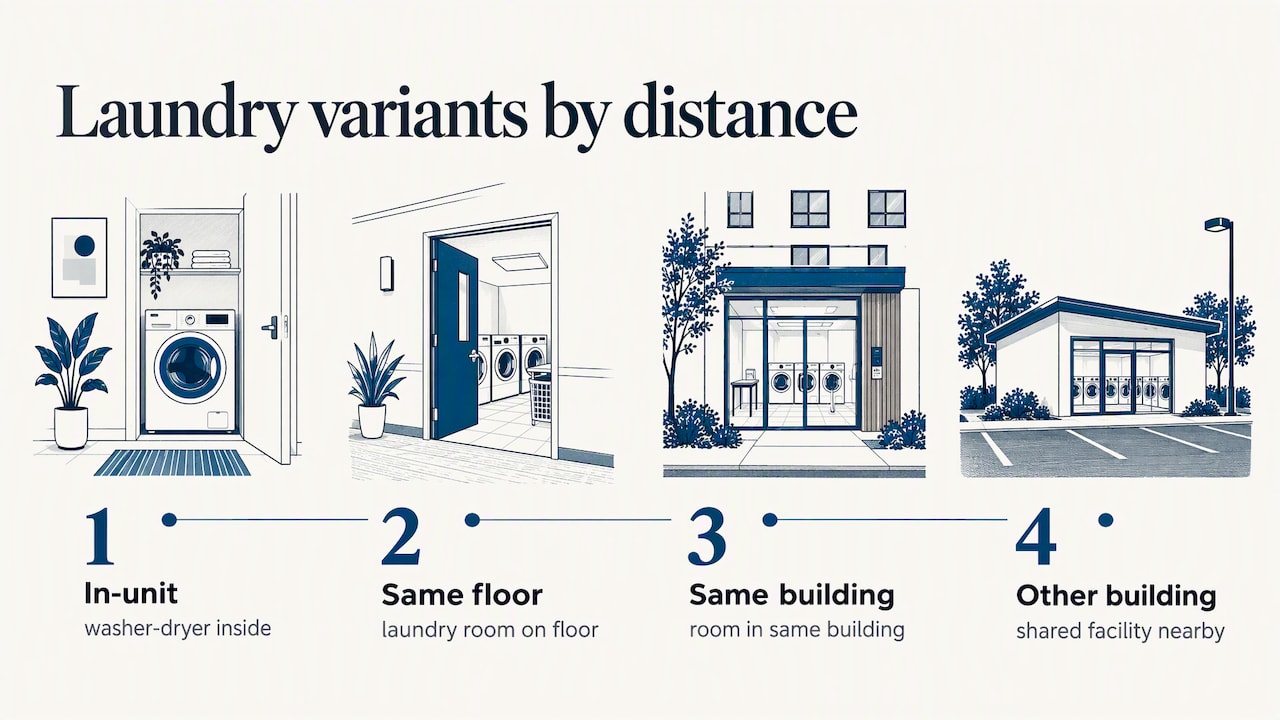
Each version changes your daily experience. A same-building room is barely different from in-unit for most people. A separate laundry building across a parking lot is a real inconvenience in bad weather or late at night. In-unit washer-dryer setups skip all of this, but they cost more in rent almost everywhere they exist. Knowing which variant you are looking at before you sign anything prevents a bad surprise during your first week.
Checklist: exact questions to ask and things to inspect
A listing that says “on-site laundry” tells you almost nothing about cost, convenience, or reliability. The only way to know what you are actually getting is to ask direct questions and, where possible, look at the room yourself. Housing office guidance recommends confirming these details directly with the landlord rather than assuming anything from the listing headline, since availability, hours, payment systems, and whether laundry is included in rent vary by property.
Work through these points on a call or during a viewing:
- Ask whether laundry is free, included in rent, or pay-per-use, and what payment method is accepted (coins, app, key fob).
- Confirm exactly where the machines are located and what hours the room is accessible.
- Ask how many machines serve the building or complex and whether residents report long waits at peak times.
- Clarify who handles repairs and how quickly a broken machine typically gets fixed.
- Ask whether laundry charges appear on your rent statement or get billed separately, and how often.
If you are touring in person, look at the room itself: lighting, cleanliness, posted rules, and the apparent age of the machines all tell you something a listing won’t. If you are renting remotely, ask for current photos or a short video walkthrough rather than relying on stock images from the listing.
Pro Tip: Call during business hours and ask to speak with building maintenance directly, not just leasing staff, since they usually know the real repair turnaround better than anyone else on-site.
Folding laundry costs into your total housing budget
Rent alone is a misleading number. Comparing apartments by total monthly housing cost, meaning rent plus utilities plus laundry and any other recurring fees, gives you a fairer comparison between two otherwise similar units.
Laundry typically gets billed one of a few ways:
- Free and included in rent, with no separate charge per load.
- A flat monthly laundry fee added to your rent statement regardless of use.
- Coin-op or app-based payment charged per load or per cycle.
- Usage billed through your utility account when the property meters water or electricity to residents.
Machine efficiency changes your utility bill when you pay for water or power directly. ENERGY STAR certified washers use about 25% less energy and 33% less water than standard models, which matters if your lease passes utility costs on to you. As a simple illustration: say a coin-op load costs $2.50 and you run six loads a month, that’s $15 added to your housing cost before you even factor in detergent or time spent waiting for a free machine.
Alternatives and when each one actually makes sense
Shared on-site laundry, in-unit machines, pickup-and-delivery, and the neighborhood laundromat all solve the same problem differently, and the right choice depends on your household, not on which option sounds most convenient in the abstract.
- Shared on-site laundry works well for single occupants or couples who wash infrequently and can plan around a predictable schedule.
- In-unit laundry earns its higher rent for families, shift workers with odd hours, or anyone with mobility limits that make carrying baskets to a separate room difficult.
- Pickup-and-delivery wash-and-fold services trade a recurring fee for near-zero effort, a reasonable option if your time is worth more than the cost difference.
- Laundromats remain a solid backup when on-site machines break down or when a short-term rental has no laundry arrangement at all.
Housing resources note that most apartment residents rely on one of exactly these four options, so weighing them against your actual weekly routine, rather than against a generic ranking, is the more useful exercise.
How managed team housing handles laundry for project crews
Project managers placing contractor or field teams rarely have time to call every property and confirm laundry hours one by one. Before booking, we verify amenities like laundry access, machine count, and payment terms across the properties we source, so a team doesn’t discover a shared laundry room is coin-op and three floors away only after arrival.
For teams working on technical sites, like semiconductor fab crew accommodation or contractor housing near major nuclear projects, consolidated invoicing means a laundry fee doesn’t show up as a surprise line item split across different landlords. Placements typically happen quickly, and ongoing support covers questions that come up mid-stay, including laundry access issues.
When booking for a group, ask your provider to confirm in writing: machine capacity relative to the number of guests staying, access hours, and exactly how payment works, whether that’s included in the booking or billed separately.
How to verify laundry claims before you sign the lease
A listing is marketing copy. The lease is the only document that protects you if the laundry arrangement turns out different from what was advertised. A practical verification process treats listings as a starting point, not a final answer, and pushes confirmation into writing before money changes hands.
- Ask for laundry terms, including fees and access hours, to be written into the lease or a signed addendum.
- Request current photos or a video walkthrough of the laundry room if you can’t view it in person.
- Confirm what happens when a machine breaks: who pays, who repairs it, and how long residents typically wait.
- Save screenshots or emails of any verbal promises a leasing agent makes, since verbal assurances rarely hold up without a paper trail.
Doing this before signing costs you ten minutes. Discovering a mismatch after move-in costs you a dispute.
Laundry room cleanliness and security considerations
A laundry room that’s locked, well lit, and monitored feels different from one tucked into an unmonitored basement corner, and the difference matters more than people expect before they’ve actually used the space at 9 p.m. on a weeknight.
Look for keyed or fob access limited to residents, since an open laundry room accessible from outside the building is a common complaint in older properties. Cameras, whether visible or just signage indicating coverage, add a layer of accountability that reduces theft of clothing left unattended mid-cycle, a surprisingly common frustration.
Cleanliness tells you how seriously a property manages the space day to day. Check the floor for standing water or lint buildup around dryer vents, which is both unpleasant and a fire hazard. Trash bins that are emptied regularly and shelves free of abandoned detergent bottles suggest routine maintenance rather than a space nobody checks on.
Hours matter for safety as much as convenience. A laundry room open 24 hours sounds appealing, but if it sits in a dim hallway with no camera coverage, a more limited schedule paired with better lighting might actually feel safer. Ask current residents, if you can, whether they feel comfortable doing laundry alone at night. That kind of informal feedback often surfaces problems a listing or a quick tour won’t show you.
Accessibility features and accommodations in on-site laundry facilities
Shared laundry rooms vary widely in how usable they are for residents with mobility limitations, and this is rarely covered in a standard listing. Front-loading machines are generally easier to use than top-loaders for anyone who has difficulty bending or reaching, and many newer properties default to front-loading units for exactly this reason.
Door width, ramp access, and the layout between the building entrance and the laundry room all affect whether someone using a wheelchair or walker can realistically manage the trip unassisted. A laundry room technically “on-site” can still be functionally inaccessible if it sits down a flight of stairs with no elevator alternative.
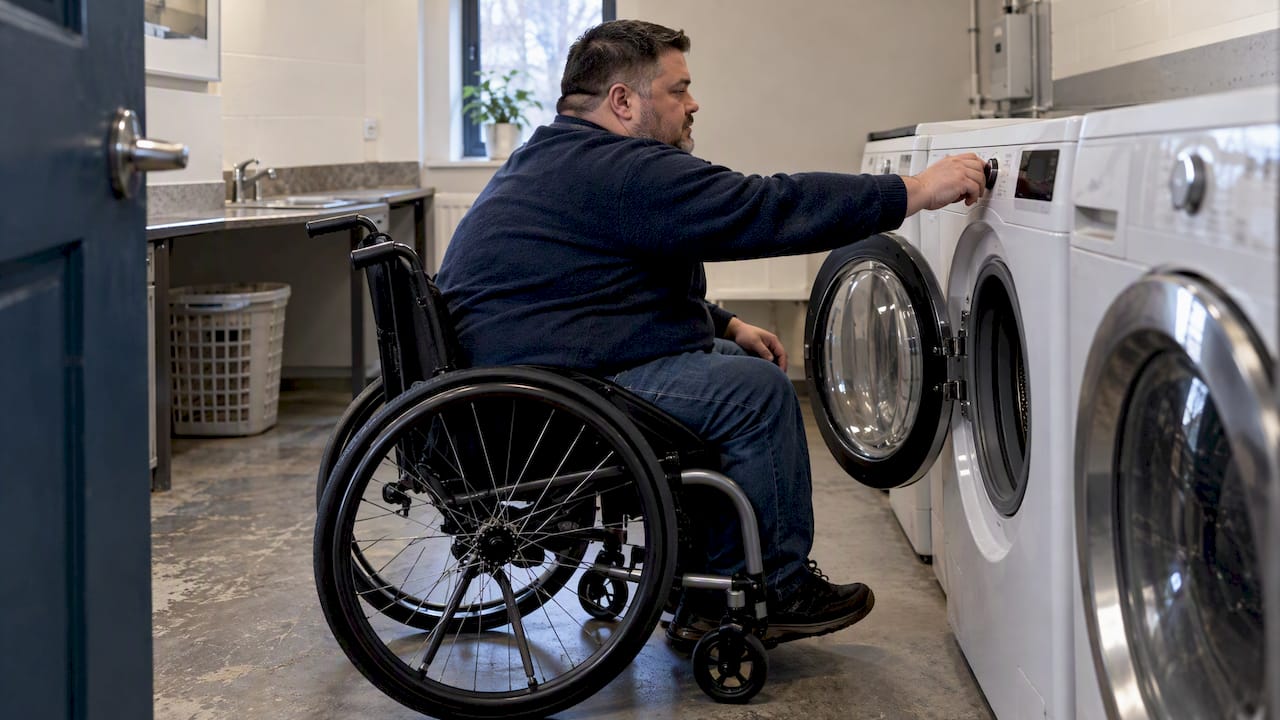
Ask directly whether the laundry room meets accessibility standards for your specific needs, since general compliance language in a listing doesn’t guarantee a workable layout for every situation. Counter height for folding, the placement of detergent dispensers, and whether carts are available for transporting laundry are small details that make a large practical difference.
If accessibility is a priority, request this information before touring rather than discovering a mismatch on move-in day. A quick phone call asking specific questions, rather than a general “is it accessible,” tends to get a more useful answer from leasing staff.
Typical issues renters report with on-site laundry
The most common complaint isn’t the existence of shared laundry, it’s unreliable machines paired with slow repairs. A single broken dryer in a building with only two machines turns laundry day into a genuine scheduling problem, and housing guidance points to confirming repair response expectations upfront as one of the clearest ways to avoid this.
Payment friction is another recurring issue: coin machines that don’t accept the only coins residents have on hand, or apps that fail during peak usage, turn a routine task into an avoidable hassle. Confirming the payment method before move-in, not after, sidesteps this.
Overcrowding at predictable times, evenings and weekends especially, means a theoretically “available” laundry room can still involve a long wait. Ask current or former residents about peak-hour wait times if you can find any feedback online before committing.
Theft of unattended clothing and the disappearance of detergent or laundry carts also show up repeatedly in renter complaints, which ties back directly to the cleanliness and security questions covered earlier. Addressing these issues mostly comes down to the same fix: ask specific questions before you sign, and get the answers in writing where it matters.
Impact of on-site laundry availability on apartment market value and rental demand
Laundry access shapes how a property competes in a given market, and it’s one of the amenities renters actively filter for when searching listings. A building with reliable on-site laundry, properly maintained and reasonably priced, tends to hold broader appeal than an otherwise comparable unit with no laundry solution at all, simply because it removes a recurring logistical problem for tenants.
In-unit laundry commands a premium almost everywhere it’s offered, which is exactly why landlords without the ability to retrofit individual units lean on shared facilities as the next-best alternative. Comparing total housing cost rather than rent alone helps explain why: a slightly higher rent for in-unit laundry can still work out cheaper than paying per load indefinitely, depending on how often you wash.
For property owners, a well-maintained shared laundry room is a relatively low-cost way to add perceived value without the capital expense of plumbing and electrical work inside every unit. That’s part of why laundry upgrades, new machines, better lighting, added security, show up disproportionately often in renovation budgets for older apartment buildings trying to stay competitive against newer construction that includes in-unit hookups by default.
Author perspective: three quick decision rules
If you do laundry weekly or more, pay for in-unit. If the shared room is close, modern, and reasonably priced, it’s good enough for occasional use. For teams, insist on written confirmation, verbal promises about laundry access rarely survive a dispute. On first contact with a landlord, ask: is it free or paid, where exactly is it located, and who fixes it when it breaks.
— Fan
Why project teams choose verified housing over guesswork
Confirming laundry arrangements for one apartment is a ten-minute task. Doing it for a crew of fifteen across three properties is a different problem entirely, and it’s exactly the kind of administrative friction we take off a project manager’s plate. We verify amenities like laundry access, machine capacity, and payment terms before booking, so a team isn’t troubleshooting a coin-op machine on day one of an assignment.
- One consolidated invoice covers the stay regardless of how many properties or landlords are involved.
- Placements typically happen promptly, with direct support continuing through the stay.
- Custom requirements, from laundry capacity to accessibility needs, get confirmed before your team arrives.
If you’re arranging housing for a contractor or project team, our contractor accommodation page is the place to start, with examples and a direct way to get in touch about your next placement.
FAQ
What does on-site laundry mean for apartments?
On-site laundry means shared washers and dryers located somewhere on the property, such as a laundry room in your building or a separate shared facility, rather than a machine installed inside your own unit. Confirming the exact location, hours, and payment method with the landlord is the only reliable way to know what you’re actually getting.
How much rent can I afford if I make $3,000 a month?
Affordability depends on your debts, household size, location, and other monthly costs, not on a single fixed formula, so comparing total housing cost, meaning rent plus utilities plus laundry and other fees, gives a far more accurate picture than rent alone. A budgeting tool or a conversation with a housing counselor can help you apply that total-cost approach to your specific income and expenses.
How do people in apartments do laundry?
Most apartment residents rely on one of four options: a shared on-site laundry room, a nearby laundromat, a pickup-and-delivery wash-and-fold service, or an in-unit washer and dryer when the property offers one. Housing resources note that which option makes sense depends mainly on how often someone washes and what the building actually provides.
Does in-unit laundry mean in your apartment?
Yes, in-unit laundry means the washer and dryer sit inside your own apartment, separate from any shared or on-site facility elsewhere on the property. This is the key distinction to confirm in a listing, since “on-site” and “in-unit” are often used loosely and can describe very different daily experiences.
Sources
- University Housing — Housing Services (Laundry as an amenity)
- ENERGY STAR — Certified clothes washers
- Redfin: In-unit laundry vs on-site laundry
- Automated Laundry — What is on-site laundry?
Recommended
On-site laundry means shared washers and dryers located somewhere on the property, not inside your apartment, and the first thing worth confirming is whether those machines are free or pay-per-use and exactly where they sit relative to your unit. Get that answer before anything else, then use the checklist below to fill in the rest.
TL;DR:
- Verify whether laundry is free, included in rent, or pay-per-use, and ask where the machines are located and what hours they are accessible.
- Confirm how many machines serve the building, and whether residents experience long waits during peak times.
- Clarify who handles repairs, how quickly broken machines are fixed, and whether laundry charges appear on rent statements or separate bills.
- Consider total monthly housing costs, including utilities and laundry, to accurately compare affordability between units.
- For project teams, ensure laundry access, machine capacity, and payment details are confirmed in writing before booking.
Table of Contents
- What on-site laundry means in listings and common variants
- Checklist: exact questions to ask and things to inspect
- Folding laundry costs into your total housing budget
- Alternatives and when each one actually makes sense
- How managed team housing handles laundry for project crews
- How to verify laundry claims before you sign the lease
- Laundry room cleanliness and security considerations
- Accessibility features and accommodations in on-site laundry facilities
- Typical issues renters report with on-site laundry
- Impact of on-site laundry availability on apartment market value and rental demand
- Author perspective: three quick decision rules
- Why project teams choose verified housing over guesswork
- FAQ
- Sources
What on-site laundry means in listings and common variants
Listings use several overlapping terms: on-site laundry, shared laundry, coin-op, and laundry room all typically point to the same thing, a shared facility somewhere on the property rather than a machine inside your unit. The variants matter more than the label. Some buildings put a laundry room on your own floor or in the basement of your building. Larger complexes often centralize machines in one shared building that serves several blocks, which means a short walk or drive depending on the layout. A few properties contract laundry out to a separate standalone building entirely.
Each version changes your daily experience. A same-building room is barely different from in-unit for most people. A separate laundry building across a parking lot is a real inconvenience in bad weather or late at night. In-unit washer-dryer setups skip all of this, but they cost more in rent almost everywhere they exist. Knowing which variant you are looking at before you sign anything prevents a bad surprise during your first week.
Checklist: exact questions to ask and things to inspect
A listing that says “on-site laundry” tells you almost nothing about cost, convenience, or reliability. The only way to know what you are actually getting is to ask direct questions and, where possible, look at the room yourself. Housing office guidance recommends confirming these details directly with the landlord rather than assuming anything from the listing headline, since availability, hours, payment systems, and whether laundry is included in rent vary by property.
Work through these points on a call or during a viewing:
- Ask whether laundry is free, included in rent, or pay-per-use, and what payment method is accepted (coins, app, key fob).
- Confirm exactly where the machines are located and what hours the room is accessible.
- Ask how many machines serve the building or complex and whether residents report long waits at peak times.
- Clarify who handles repairs and how quickly a broken machine typically gets fixed.
- Ask whether laundry charges appear on your rent statement or get billed separately, and how often.
If you are touring in person, look at the room itself: lighting, cleanliness, posted rules, and the apparent age of the machines all tell you something a listing won’t. If you are renting remotely, ask for current photos or a short video walkthrough rather than relying on stock images from the listing.
Pro Tip: Call during business hours and ask to speak with building maintenance directly, not just leasing staff, since they usually know the real repair turnaround better than anyone else on-site.
Folding laundry costs into your total housing budget
Rent alone is a misleading number. Comparing apartments by total monthly housing cost, meaning rent plus utilities plus laundry and any other recurring fees, gives you a fairer comparison between two otherwise similar units.
Laundry typically gets billed one of a few ways:
- Free and included in rent, with no separate charge per load.
- A flat monthly laundry fee added to your rent statement regardless of use.
- Coin-op or app-based payment charged per load or per cycle.
- Usage billed through your utility account when the property meters water or electricity to residents.
Machine efficiency changes your utility bill when you pay for water or power directly. ENERGY STAR certified washers use about 25% less energy and 33% less water than standard models, which matters if your lease passes utility costs on to you. As a simple illustration: say a coin-op load costs $2.50 and you run six loads a month, that’s $15 added to your housing cost before you even factor in detergent or time spent waiting for a free machine.
Alternatives and when each one actually makes sense
Shared on-site laundry, in-unit machines, pickup-and-delivery, and the neighborhood laundromat all solve the same problem differently, and the right choice depends on your household, not on which option sounds most convenient in the abstract.
- Shared on-site laundry works well for single occupants or couples who wash infrequently and can plan around a predictable schedule.
- In-unit laundry earns its higher rent for families, shift workers with odd hours, or anyone with mobility limits that make carrying baskets to a separate room difficult.
- Pickup-and-delivery wash-and-fold services trade a recurring fee for near-zero effort, a reasonable option if your time is worth more than the cost difference.
- Laundromats remain a solid backup when on-site machines break down or when a short-term rental has no laundry arrangement at all.
Housing resources note that most apartment residents rely on one of exactly these four options, so weighing them against your actual weekly routine, rather than against a generic ranking, is the more useful exercise.
How managed team housing handles laundry for project crews
Project managers placing contractor or field teams rarely have time to call every property and confirm laundry hours one by one. Before booking, we verify amenities like laundry access, machine count, and payment terms across the properties we source, so a team doesn’t discover a shared laundry room is coin-op and three floors away only after arrival.
For teams working on technical sites, like semiconductor fab crew accommodation or contractor housing near major nuclear projects, consolidated invoicing means a laundry fee doesn’t show up as a surprise line item split across different landlords. Placements typically happen quickly, and ongoing support covers questions that come up mid-stay, including laundry access issues.
When booking for a group, ask your provider to confirm in writing: machine capacity relative to the number of guests staying, access hours, and exactly how payment works, whether that’s included in the booking or billed separately.
How to verify laundry claims before you sign the lease
A listing is marketing copy. The lease is the only document that protects you if the laundry arrangement turns out different from what was advertised. A practical verification process treats listings as a starting point, not a final answer, and pushes confirmation into writing before money changes hands.
- Ask for laundry terms, including fees and access hours, to be written into the lease or a signed addendum.
- Request current photos or a video walkthrough of the laundry room if you can’t view it in person.
- Confirm what happens when a machine breaks: who pays, who repairs it, and how long residents typically wait.
- Save screenshots or emails of any verbal promises a leasing agent makes, since verbal assurances rarely hold up without a paper trail.
Doing this before signing costs you ten minutes. Discovering a mismatch after move-in costs you a dispute.
Laundry room cleanliness and security considerations
A laundry room that’s locked, well lit, and monitored feels different from one tucked into an unmonitored basement corner, and the difference matters more than people expect before they’ve actually used the space at 9 p.m. on a weeknight.
Look for keyed or fob access limited to residents, since an open laundry room accessible from outside the building is a common complaint in older properties. Cameras, whether visible or just signage indicating coverage, add a layer of accountability that reduces theft of clothing left unattended mid-cycle, a surprisingly common frustration.
Cleanliness tells you how seriously a property manages the space day to day. Check the floor for standing water or lint buildup around dryer vents, which is both unpleasant and a fire hazard. Trash bins that are emptied regularly and shelves free of abandoned detergent bottles suggest routine maintenance rather than a space nobody checks on.
Hours matter for safety as much as convenience. A laundry room open 24 hours sounds appealing, but if it sits in a dim hallway with no camera coverage, a more limited schedule paired with better lighting might actually feel safer. Ask current residents, if you can, whether they feel comfortable doing laundry alone at night. That kind of informal feedback often surfaces problems a listing or a quick tour won’t show you.
Accessibility features and accommodations in on-site laundry facilities
Shared laundry rooms vary widely in how usable they are for residents with mobility limitations, and this is rarely covered in a standard listing. Front-loading machines are generally easier to use than top-loaders for anyone who has difficulty bending or reaching, and many newer properties default to front-loading units for exactly this reason.
Door width, ramp access, and the layout between the building entrance and the laundry room all affect whether someone using a wheelchair or walker can realistically manage the trip unassisted. A laundry room technically “on-site” can still be functionally inaccessible if it sits down a flight of stairs with no elevator alternative.
Ask directly whether the laundry room meets accessibility standards for your specific needs, since general compliance language in a listing doesn’t guarantee a workable layout for every situation. Counter height for folding, the placement of detergent dispensers, and whether carts are available for transporting laundry are small details that make a large practical difference.
If accessibility is a priority, request this information before touring rather than discovering a mismatch on move-in day. A quick phone call asking specific questions, rather than a general “is it accessible,” tends to get a more useful answer from leasing staff.
Typical issues renters report with on-site laundry
The most common complaint isn’t the existence of shared laundry, it’s unreliable machines paired with slow repairs. A single broken dryer in a building with only two machines turns laundry day into a genuine scheduling problem, and housing guidance points to confirming repair response expectations upfront as one of the clearest ways to avoid this.
Payment friction is another recurring issue: coin machines that don’t accept the only coins residents have on hand, or apps that fail during peak usage, turn a routine task into an avoidable hassle. Confirming the payment method before move-in, not after, sidesteps this.
Overcrowding at predictable times, evenings and weekends especially, means a theoretically “available” laundry room can still involve a long wait. Ask current or former residents about peak-hour wait times if you can find any feedback online before committing.
Theft of unattended clothing and the disappearance of detergent or laundry carts also show up repeatedly in renter complaints, which ties back directly to the cleanliness and security questions covered earlier. Addressing these issues mostly comes down to the same fix: ask specific questions before you sign, and get the answers in writing where it matters.
Impact of on-site laundry availability on apartment market value and rental demand
Laundry access shapes how a property competes in a given market, and it’s one of the amenities renters actively filter for when searching listings. A building with reliable on-site laundry, properly maintained and reasonably priced, tends to hold broader appeal than an otherwise comparable unit with no laundry solution at all, simply because it removes a recurring logistical problem for tenants.
In-unit laundry commands a premium almost everywhere it’s offered, which is exactly why landlords without the ability to retrofit individual units lean on shared facilities as the next-best alternative. Comparing total housing cost rather than rent alone helps explain why: a slightly higher rent for in-unit laundry can still work out cheaper than paying per load indefinitely, depending on how often you wash.
For property owners, a well-maintained shared laundry room is a relatively low-cost way to add perceived value without the capital expense of plumbing and electrical work inside every unit. That’s part of why laundry upgrades, new machines, better lighting, added security, show up disproportionately often in renovation budgets for older apartment buildings trying to stay competitive against newer construction that includes in-unit hookups by default.
Author perspective: three quick decision rules
If you do laundry weekly or more, pay for in-unit. If the shared room is close, modern, and reasonably priced, it’s good enough for occasional use. For teams, insist on written confirmation, verbal promises about laundry access rarely survive a dispute. On first contact with a landlord, ask: is it free or paid, where exactly is it located, and who fixes it when it breaks.
— Fan
Why project teams choose verified housing over guesswork
Confirming laundry arrangements for one apartment is a ten-minute task. Doing it for a crew of fifteen across three properties is a different problem entirely, and it’s exactly the kind of administrative friction we take off a project manager’s plate. We verify amenities like laundry access, machine capacity, and payment terms before booking, so a team isn’t troubleshooting a coin-op machine on day one of an assignment.
- One consolidated invoice covers the stay regardless of how many properties or landlords are involved.
- Placements typically happen promptly, with direct support continuing through the stay.
- Custom requirements, from laundry capacity to accessibility needs, get confirmed before your team arrives.
If you’re arranging housing for a contractor or project team, our contractor accommodation page is the place to start, with examples and a direct way to get in touch about your next placement.
FAQ
What does on-site laundry mean for apartments?
On-site laundry means shared washers and dryers located somewhere on the property, such as a laundry room in your building or a separate shared facility, rather than a machine installed inside your own unit. Confirming the exact location, hours, and payment method with the landlord is the only reliable way to know what you’re actually getting.
How much rent can I afford if I make $3,000 a month?
Affordability depends on your debts, household size, location, and other monthly costs, not on a single fixed formula, so comparing total housing cost, meaning rent plus utilities plus laundry and other fees, gives a far more accurate picture than rent alone. A budgeting tool or a conversation with a housing counselor can help you apply that total-cost approach to your specific income and expenses.
How do people in apartments do laundry?
Most apartment residents rely on one of four options: a shared on-site laundry room, a nearby laundromat, a pickup-and-delivery wash-and-fold service, or an in-unit washer and dryer when the property offers one. Housing resources note that which option makes sense depends mainly on how often someone washes and what the building actually provides.
Does in-unit laundry mean in your apartment?
Yes, in-unit laundry means the washer and dryer sit inside your own apartment, separate from any shared or on-site facility elsewhere on the property. This is the key distinction to confirm in a listing, since “on-site” and “in-unit” are often used loosely and can describe very different daily experiences.
Sources
- University Housing — Housing Services (Laundry as an amenity)
- ENERGY STAR — Certified clothes washers
- Redfin: In-unit laundry vs on-site laundry
- Automated Laundry — What is on-site laundry?
Recommended

Contact us today to discuss your next project